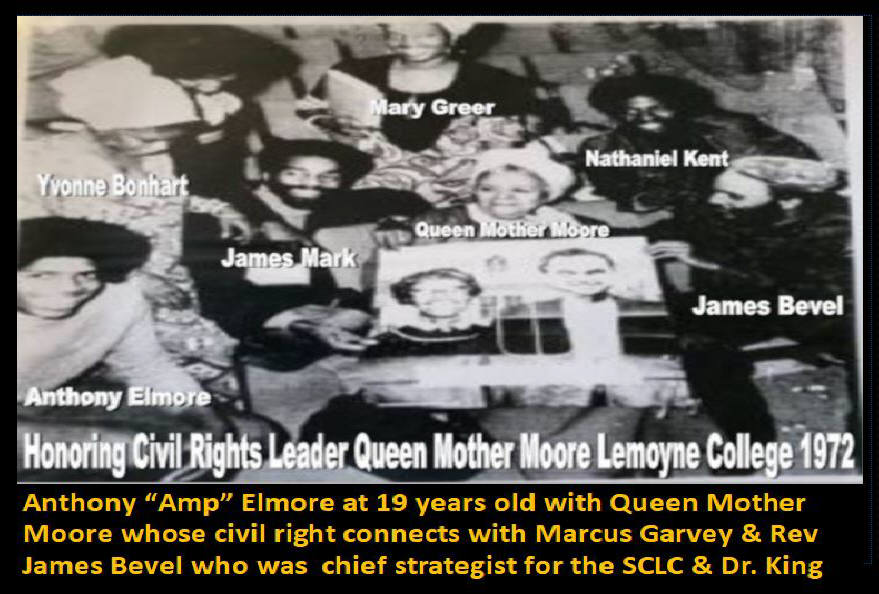
Elmore 1972 Civil Rights Roots
**The Awakening: From Hamilton High to Grassroots Defiance**
Long before entering a championship ring or behind a motion picture camera, Anthony "Amp" Elmore was forged in the fire of Memphis activism and unapologetic African identity. In the 1971 Hamilton High School yearbook, Elmore rejected standard colonial naming and established his cultural identity by adopting an African nickname. Decades ahead of his era, he wore his hair in cornrow braids—a cultural statement so disruptive to the status quo that the school principal threatened immediate suspension unless the braids were removed.
When graduation day arrived, Elmore refused to walk. He boycotted the ceremony after learning that high-achieving students were mandated to wear white robes—a tradition he called out as symbolic "White Superiority." Refusing to compromise, he channeled his energy directly into political empowerment, organizing and leading the very first 18-year-old voter registration drive in Tennessee right out of Hamilton High.
Becoming a Disciple: Rev. James Bevel and the Lorraine Motel Legacy
While enrolled at Memphis State University, Elmore encountered Rev. James Bevel—the master strategist of the Southern Christian Leadership Conference (SCLC) and Dr. Martin Luther King Jr.’s chief lieutenant who architected the 1963 Birmingham Children's Crusade and the historic 1965 Selma-to-Montgomery March.
On April 4, 1968, when Dr. King was murdered in Memphis at the Lorraine Motel, the balcony room where Dr. King was assassinated was originally the room registered to Rev. James Bevel before an intentional last-minute switch. At the exact moment the shot was fired, Bevel stood directly in the parking lot below. Shattered by Dr. King's assassination, Rev. Bevel took a sabbatical, ultimately returning to Memphis in 1971 to complete Dr. King’s unfinished work.
Hearing the call to action, 19-year-old Elmore made the bold decision to leave college in 1972 to become a full-time disciple of Rev. Bevel. That same year, Elmore journeyed to Gary, Indiana for the historic first National Black Political Convention (March 10–12, 1972), standing alongside thousands of Black leaders demanding self-determination and political independence.
The 1972 Historic Photograph: Garvey, King, and the "Night Time University
The historic 1972 photograph at LeMoyne College documents Rev. Bevel’s "Night Time University"—an intensive organizing and political education circle. Captured at just 19 years old, Elmore sits alongside:
Queen Mother Audley Moore: The pioneer of Marcus Garvey’s 1920s Universal Negro Improvement Association (UNIA) and the godmother of the modern Black reparations and African self-determination movements. (In the photograph, she is shown holding a satirical mock portrait poking fun at segregationist Alabama Governor George Wallace).
Rev. James Bevel: SCLC Chief Strategist, wearing his trademark skull cap and directing the ideological line between nonviolence and Pan-African liberation.
In that room, the two greatest ideological streams of modern Black history—Marcus Garvey’s Pan-African nationalism and Dr. Martin Luther King Jr.’s direct-action movement—converged directly into 19-year-old Anthony "Amp" Elmore.
Cinematic History: First to Put Rev. Bevel on the 35mm Screen
While Hollywood’s 2014 film *Selma* dramatized Rev. James Bevel, it was Anthony "Amp" Elmore who first made cinematic history by immortalizing Bevel’s teachings on 35mm film in his 1988 independent theatrical release, The Contemporary Gladiator.
Filmed in Memphis in 1987, the movie captured Rev. Bevel’s actual street-level philosophy, referencing him simply and reverently as "Rev."
Click here to watch the historic Rev. James Bevel Scene from The Contemporary Gladiator
Click here to watch the Dinner Scene where Anthony "Amp" Elmore explains our sacred connection to African heritage and diet
The Modern Continuation: The African Cultural Embassy
This unbroken 50-plus-year journey did not end in the 1970s or the 1980s. To ensure that Dr. King’s global vision and Rev. Bevel’s mandate for African empowerment never died, Anthony "Amp" Elmore founded The African Cultural Embassy at 1035 Semmes Street in historic Orange Mound.
Today, through the **African Cultural Diplomat Exchange Network**, this living legacy directly connects the youth of Memphis with our ancestral family across Africa—transforming elementary classrooms into sovereign hubs of cultural diplomacy, truth, and generational brotherhood.
