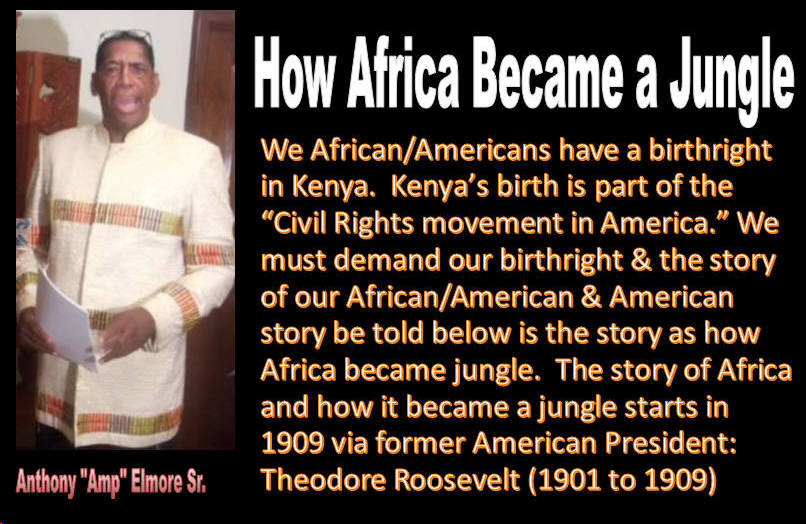
In March 1909, mere weeks after vacating the White House, former U.S. President Theodore Roosevelt embarked on an epic, year-long expedition through British East Africa,(Kenya) the Belgian Congo, and Sudan, financed by Andrew Carnegie and commissioned by the Smithsonian Institution. This historic trek was the first truly global multimedia news spectacle. For over a year, international wire services, serialized newspaper columns, motion picture newsreels, and Roosevelt’s own 1910 bestselling book, *African Game Trails*, beamed daily dispatches across the Western world.
What the public consumed, however, was not an accurate account of sovereign African peoples, complex civilizations, or millennia-old pastoral traditions. Instead, it was a carefully curated theater of colonial domination: a dramatic staging ground where white imperialists conquered a perilous, untamed wilderness teeming with big game and "savage" natives.
The Birth of the Tarzan Mythos and White Hegemony
Roosevelt’s heavily sensationalized journey ignited an insatiable Western appetite for the "Dark Continent," directly inspiring American author Edgar Rice Burroughs to publish *Tarzan of the Apes* in 1912. Burroughs—who had never set foot on the continent—synthesized Roosevelt’s safari dispatches into a virulent ideological narrative. In the world of Tarzan, a white English aristocrat raised by apes instantly assumes his "natural" position at the pinnacle of the African hierarchy, mastering the wild animals and subduing native populations depicted as superstitious, primitive, and linguistically deficient.
This framework was not benign entertainment; it was a foundational pillar of white supremacy designed to justify European colonization and racial subjugation. The trope was later cemented in the literary canon by writers like Ernest Hemingway, whose works (*Green Hills of Africa*, *The Snows of Kilimanjaro*) romanticized the colonial safari—transforming the Swahili word *safari* (meaning simply "journey") into an exclusive, aristocratic playground where wealthy Westerners found existential rebirth against an exotic, silent African backdrop.
1909: Roosevelt's Smithsonian Expedition (Media Spectacle)
1912: Burroughs publishes "Tarzan of the Apes"
1930s-1950s: Hollywood Tarzan films & Hemingway Safari literature
2026: 117 Years of Subconscious "Jungle" Conditioning
The Subconscious Trauma of the African Diaspora
Over the course of 117 years (1909–2026), through hundreds of Hollywood films, radio plays, comic strips, and television broadcasts, this manufactured reality colonized the subconscious mind of the Western public. Tragically, it wrought the deepest psychological toll on African Americans. Stripped of their specific ancestral origins through 246 years of chattel slavery, 99 years of Jim Crow, and decades of tokenism, Black Americans were forced to view their motherland exclusively through the lens of Hollywood propaganda.
Generations grew up seeing Africa framed solely as mud huts, impenetrable rainforests, ferocious predators, and unintelligible dialects. This systemic media conditioning created deep-seated cultural alienation and historical embarrassment, severing the natural emotional bridge between continental Africans and the African Diaspora. Even when modern observers are presented with visual evidence of contemporary African metropolises, the subconscious mind still defaults to the primitive, fictional jungle engineered more than a century ago.
Reclaiming the True Kenyan Heritage
The historical truth stands in total opposition to the colonial safari narrative. East Africa’s authentic wilderness stewardship and pastoralist culture do not belong to Roosevelt, Hemingway, or Hollywood—they represent sophisticated, community-led traditions over 1,000 years old. Civilizations across the Rift Valley and the East African coast developed sustainable coexistence with wildlife, intricate legal and governing codes, advanced trade routes across the Indian Ocean, and deep philosophical traditions long before Western colonizers arrived.
Dismantling 117 years of ideological distortion requires an aggressive reclamation of history: replacing Hollywood fictions with authentic digital archiving, direct trade partnerships, independent media, and an institutionalized recognition of kinship between continental Africans and the global diaspora.
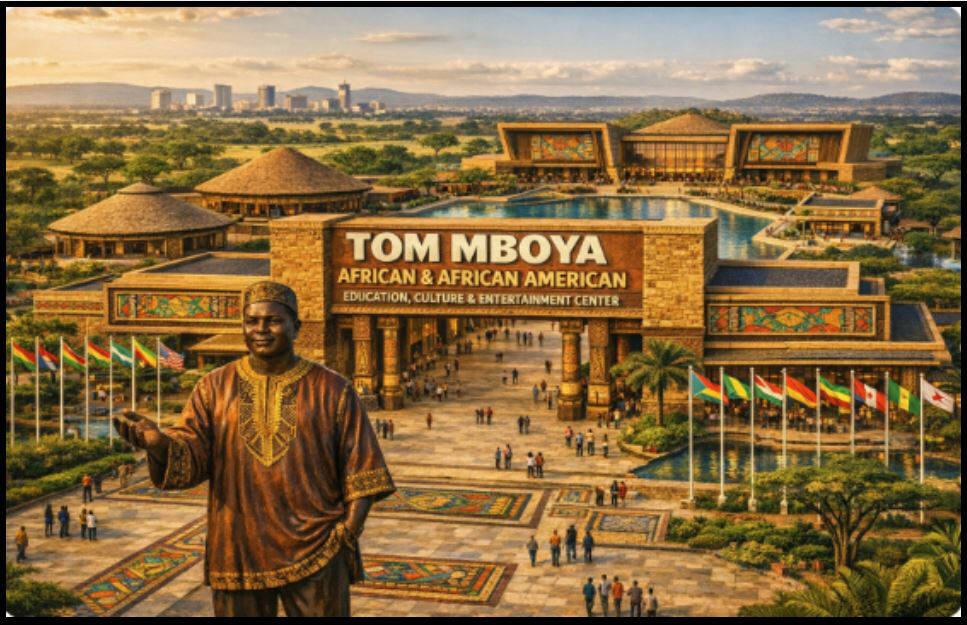
The Tom Mboya African & African American Education, Culture & Entertainment Center
Conceived, Authored, and Championed by Anthony "Amp" Elmore *Founder & President, The African Cultural Embassy, *Founder, African Cultural Diplomat Exchange Network, *Five-Time World Heavyweight Kickboxing Champion & Independent Filmmaker.
From Jungle to Jubilee: The Strategic Vision of Anthony "Amp" Elmore
For more than a century, Western cinema, media, and institutional narratives conditioned the global public—and African Americans in particular—to view Africa through the distorted lens of a primitive "jungle."
**Anthony "Amp" Elmore** has stepped forward with the definitive solution to shatter that stereotype once and for all: The Tom Mboya African & African American Education, Culture & Entertainment Center.
While Las Vegas was constructed in a barren desert, Kenya is blessed with natural majesty, year-round sun, and an ancient ancestral heritage. Yet, as Elmore boldly asserts, Kenya’s global destiny cannot remain limited to tourists viewing wild animals on safari. African Americans and international travelers do not cross oceans to see outdated tropes of spears and wilderness; they seek world-class **Education, Culture, and Entertainment**.
Under Anthony "Amp" Elmore’s vision, Kenya is positioned to become the real-world **Wakanda**—a premier global destination where architectural innovation, high-level scholarship, Pan-African trade, and diaspora kinship converge.
